The months when Korouoma's waterfalls freeze
The ice in Korouoma canyon follows the cold, not a calendar. It usually forms around December, tends to be thickest from January to March and starts to soften in April. Below, month by month, we set the ice against daylight and cold so you can pick your dates with open eyes.
How the ice builds each winter
The falls at Korouoma are not rivers dropping over a ledge. Water seeps out of the cliff walls all year, and once the frost sets in it freezes where it runs. Layer by layer, those frozen seeps slowly grow into curtains and columns of ice.
That makes the timing a matter of weather rather than dates. The ice usually starts to form around December and tends to be thickest from January to March. It begins to soften in April, and a mild spell can shift either end.
No operator can promise ice on a given day, and neither can we. The table shows the usual pattern, and our guide to the frozen falls describes what you see once you get there.
| Month | Ice (usually) | Daylight | Cold |
|---|---|---|---|
| December | Forming, often thinner | A few hours | Cold, getting colder |
| January | Solid and growing | Short but lengthening | Coldest stretch |
| February | Solid, often at its fullest | Longer and brighter | Coldest stretch |
| March | Mostly holding, wetter late in the month | Long, often sunny days | Milder |
| April | Thawing | Long days | Mild, wet underfoot |
First ice and short days in December
Early winter brings the shortest days of the year. Rovaniemi still gets a few hours of light around midwinter, so a canyon day passes largely in soft blue twilight, with part of the drive likely in the dark.
The ice is often still building, so the falls can look thinner than in the photos you have seen online. Some winters it forms early and fast, others later. Guides tend to know how far along it is that week.
The weeks around Christmas are the busiest in Rovaniemi, when families arrive for the Santa side of town. Small-group tours can fill early then. Book ahead and lean on the free cancellation that all four tours offer up to 24 hours before.
Solid ice and deep cold in January and February
These two months give the best odds of thick, wide ice. One reviewer who went in March advised January or February for a fuller show, which matches the general pattern in the canyon.
They are also the coldest weeks of the year. Days of −10 to −20 °C (14 to −4 °F) are common, and one reviewer met −30 °C (−22 °F). You sweat on the climbs and chill fast at the falls, which our guide on what to wear deals with layer by layer.
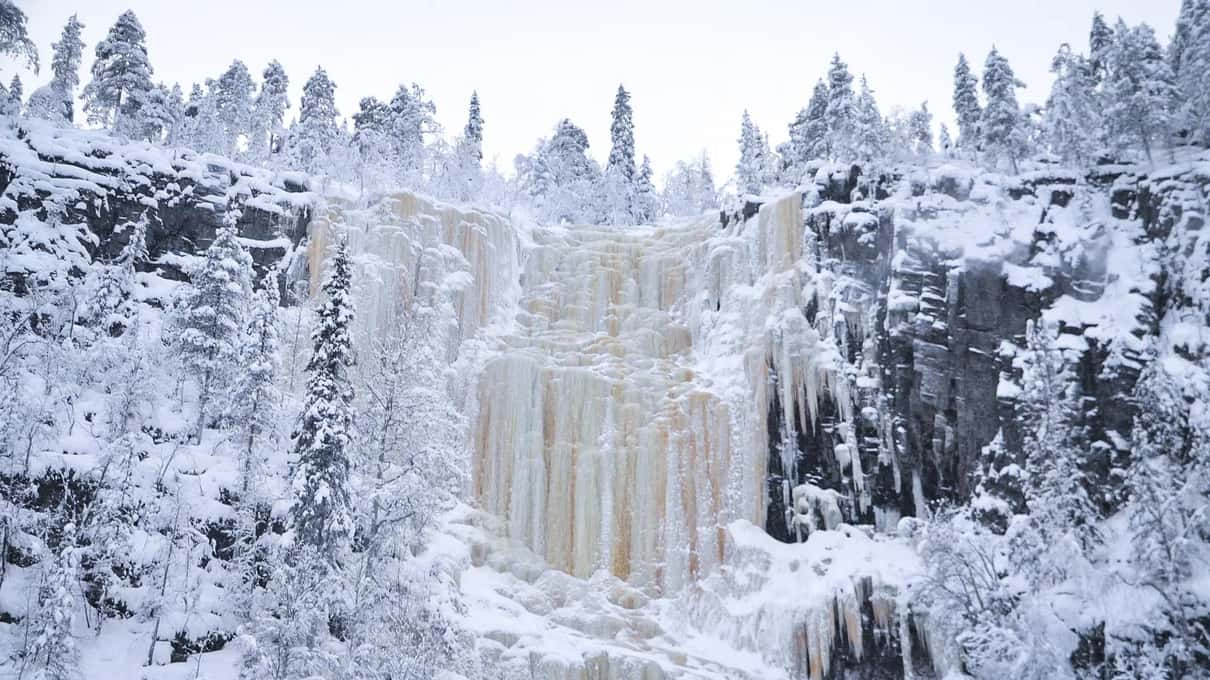
Daylight grows quickly through these weeks. By February the days are noticeably longer and brighter, and pictures of the ice come out less grey than in midwinter.
The lowest price for the coldest months is Arctic GM's hike and BBQ from ~$89, which lends thermal overalls for the day. It holds 4.9 from 1,600+ reviews on GetYourGuide.
Long light and a softer trail in March
March is the month photographers tend to like. Days are long and often sunny, with snow still heavy on the spruce. The cold eases too, so twenty minutes standing at a fall feels pleasant rather than brave.
The ice usually holds through the month, but it starts to change. A reviewer found March already wet underfoot, and another, late in the month, saw most of the snow gone. Early March is the safer half if ice is your main reason to go.
Wet snow and meltwater can make the steep sections slicker, not easier. Every tour lends spikes or grips, and our guide to the hike covers the climbs in detail.
If the light matters to you, Beyond Arctic's photo hike from ~$163 builds the day around it. Its guide is also a photographer and sends edited pictures of you at the ice after the tour, which the photo tour guide weighs against shooting your own.
Bright late-winter ice, with a photographer along
Beyond Arctic's 6.5-hour day for at most 8 guests. Warm clothing and boots are lent, and a light lunch is cooked on a fire at a lean-to. Edited photos of you at the falls follow online.
April and the thaw
By April the sun is strong and the days run long into the evening. That warmth is what loosens the ice, and falls that looked solid a few weeks earlier start to drip and turn grey.
Tours run as long as the ice holds. If April is your only window, book with free cancellation. Ask the operator about conditions a few days before, and treat an April booking as a gamble, not a sure thing.
Autumn hikes in the canyon also exist, trading the ice for flowing water and colored leaves. They are a different trip, and this site sticks to the frozen months.
Trading light against ice
The trade-off runs in one direction. Earlier in winter you get less light and less certain ice. Later you get more light and milder air, but the ice starts to fade.
For most people the middle of the season, from January into early March, gives the best odds. If you hate the cold, late February to early March is kinder. If you want the thickest ice and do not mind deep frost, choose January.
Short days also shape your evenings. Darkness comes early, which suits anyone hoping to add an aurora tour after the canyon, as our guide to pairing ice falls and northern lights explains.
Fitting the date around your stay
Most visitors base themselves in Rovaniemi for a few days, and the Korouoma trip takes roughly 6–7 hours door to door. Put it early in your stay so that a cancelled tour or a stormy day leaves time to rebook.
All four tours cancel free up to 24 hours ahead, and GetYourGuide lets you reserve now and pay later. That flexibility helps when a cold snap or a warm spell changes the forecast.
Winter roads and short daylight change that sum too if you are weighing a rental car instead. Our tour or self-drive guide goes through it, and the cost guide lines up the four prices.